payments-api #482 · merged PR
docfit bot commented
Docs updated. developer-docs #91 changes 3 pages and is waiting for @docs-team.
Documentation CI for GitHub
When a PR merges, DocFit finds the docs pages it made wrong, makes the smallest edit that fixes them, checks the result and opens a pull request. Your team reviews and merges it.
Deterministic signals first. AI judgement second. Verification last.
Free for public repos 14-day Team trial No card
Priya merges payments-api pull request 482, which adds a refund reason and closes Jira ticket API-1234. DocFit queues a docs run straight away, then reads the diff, commits, review comments and the ticket.
DocFit writes a structured change record: POST /v2/refunds gains an optional reason enum, refund.created carries it, the change is not breaking. It then ranks the docs pages the change affects, each with a reason: refunds.mdx from the API spec diff, refund-events.mdx from code, the changelog from a repo rule. The overview page scores below the threshold and is left alone.
DocFit adds a reason ParamField to refunds.mdx and updates the curl example, then runs the repository's own docs build, markdownlint and Vale, a link check over 214 links and Spectral on the OpenAPI file. All four pass on the first attempt, so confidence is High.
DocFit opens developer-docs pull request 91 with a one-line verdict, a table of the three pages it changed and why, and the checks that passed. It comments on the merged code PR and pings the docs channel in Slack. A human reviews and merges.
Example run: payments-api #482 → developer-docs #91, one merge in, one checked docs PR out
Works with the docs and GitHub workflow you already have
< 5min
to your first docs PR, run on merges you already made
4checks
build, lint, links and spec, before a human looks
0merges
made by DocFit. Your team decides what ships
∞teammates
No per-seat pricing. Invite the whole team
Every merge can make a page wrong. Nobody owns the update, and the first person to notice is usually a customer, reading about a field that no longer exists.
Nobody owns the update
The docs task sits in a ticket nobody picks up. Writers find out about the change from a support thread.
Nothing connects the merge to the page
Your docs host renders pages. Your code reviewer reads diffs. Neither knows which page a merged diff made wrong.
Catch-up never catches up
A docs sprint fixes last quarter. By the time it merges, this week's changes have already drifted.
Every time docs fall behind, someone pays for it: an engineer gets interrupted, support answers the same question again, or a customer follows instructions that no longer match the product.
One merge, two workflows
Code merged
A field is added to POST /v2/refunds
Nobody notices
The docs still describe the old request
A customer does
Support gets the question, days or weeks later
A docs ticket is filed
It waits behind feature work
An engineer rebuilds the context
Finds the PR, the ticket, the pages
Docs updated later, or never
Meanwhile, the next merge has drifted
Code merged
A field is added to POST /v2/refunds
Docs impact found
From the diff, the API spec and the ticket
Pages edited
The smallest change that makes them right
Checks run
Build, lint, links and spec
Docs PR opened
With a reason for every page
Your team reviews and merges
In GitHub, like any other PR
The docs work never disappears. It just arrives late, from a customer.No docs ticket, no context-gathering, no sprint. One PR to review.
No new docs platform, no docs sprint, no extra task after every merge. DocFit turns docs upkeep into a normal engineering workflow your team already knows how to review.
Engineering leads
Get engineers back. Docs maintenance stops depending on someone remembering that a code change also changed a page.
Maintainers
Stale pages stop piling up. Every merge is checked, and changes with no docs impact stop on their own.
Developers
No docs task to remember after the merge. The context is read from your PR and ticket, not your memory.
Reviewers
A normal pull request, already checked, with a reason for every page it touches.
DocFit isn't an AI with access to your repo, guessing which pages look related. It works out what a merge actually affected, makes the smallest edit, proves it, and hands the decision to your team.
DocFit reads the PR the way a reviewer would, and the ticket behind it, so the docs explain intent, not just the new field, and a ticket's acceptance criteria end up on the page.
Pull request
Add refund reason to POST /v2/refunds
#482 · 3 commits · 2 review comments
Diff
src/refunds/create.ts+18 −2
openapi/spec.yaml+9
src/events/RefundEvent.ts+3
Ticket · API-1234
Refund reason on create refund
3 acceptance criteria · fix version 2.14
Skip check · fast model, under a cent
Docs affected public endpoint and webhook payload changed
Change record
POST /v2/refundsreason enum · optionalrefund.created carries reasonpayments-api #483 · Refactor retry helper
No docs impact. Only tests and an internal helper changed.
The whole change, not just the diff
PR title and body, commits, review comments, and the linked ticket's description and acceptance criteria.
Jira Cloud, Linear and GitHub Issues
The ticket is found from the branch, title, commits and body, limited to the projects you allow.
Skips cheaply, and says why
A fast first pass decides whether docs can be affected at all. If not, one comment on the PR, and no credits used.
[A-Z][A-Z0-9]+-\d+ in the branch, title, commits and body, in that order; GitHub Issues links like Fixes #123 count too.Not every changed file means a docs change, and DocFit doesn't treat semantic similarity as proof. It combines the change itself, the API spec, code symbols, repo history and your rules to decide what's affected.
Deterministic signals first
An OpenAPI diff of the changed operations, and code symbols from the diff (routes, exports, enums, env vars, CLI flags) matched word for word against your pages.
What your team did before
Pages that similar changes touched in past runs and reviewer-merged PRs, plus your rules that name paths.
Every page has a reason
Pages are ranked with the signal that found them. Weak matches are left alone, not guessed at.
The difference between a docs PR you can merge and one you have to rewrite is proof. Every docs PR ships with the result of your own build and lint, not a model's word for it.
Framework defaults, when you have no commands
Hard limits on every edit
Minimal edits in your framework's idiom
MDX components like <ParamField>, frontmatter, nav files, OpenAPI descriptions and examples. Your rules apply on every run.
Build, lint, links, spec
Your docs build, markdownlint and Vale with your config, internal and external links, Redocly or Spectral on the spec.
Code samples that actually run
curl, JS, Python and PHP samples run against a mock built from your spec (Team), or your own sandbox (Growth).
The AI is boxed in
It only touches your docs, has no network access, and the final diff is checked before the PR opens.
checks.commands, then package.json scripts, Makefile targets and CI steps. Framework defaults only fill the gaps.Human-controlled by design: DocFit opens the PR, your team decides what ships. It never changes a ticket's status or writes outside its own docfit/ branches.
payments-api #482 · merged PR
docfit bot commented
Docs updated. developer-docs #91 changes 3 pages and is waiting for @docs-team.
API-1234 · comment
DocFit · 2 min ago
DocFit: docs PR developer-docs #91 opened. 3 pages updated, checks passed.
docs-updated status unchanged
#docs
DocFit APP
Docs PR ready for review · developer-docs #91
payments-api #482 · 3 pages · checks passed · High
Monday digest · example
Your docs kept up with 11 merges last week
New rule learned: "Write API key, never api-key or token." Approve
A PR body you can scan in ten seconds
A one-line verdict, a table of pages and why, check results, confidence and the rules it used.
Drafts when it isn't sure
Low confidence or failed checks open a draft instead of a ready PR.
Reports back where you work
One comment on the merged PR, one on the ticket, a Slack ping with View and Skip, and a Monday digest.
Steer it from the PRTeam
@docfit regenerate, explain, include <path> and skip, right in the conversation.
docfit/<repo>-pr-<n> branch and PR instead of opening a duplicate.DocFit isn't your docs platform. It's the layer that keeps the docs inside it from drifting. Your docs stay in Git, your build stays in place, and DocFit contributes through normal pull requests.
1# every key is optional; auto-detect fills the rest2trigger:3 branches: [main, release/*]4 paths_include: [src/api/**, openapi/**]5 skip_labels: [no-docs]6 skip_authors: [dependabot[bot]]7docs:8 mode: external9 repo: acme/developer-docs10 path: docs/payments11 framework: mintlify12 openapi: openapi/spec.yaml13tickets:14 provider: jira15 projects: [API, PLAT]16checks:17 commands: [pnpm docs:build, pnpm docs:lint]18 links: true19 openapi_lint: true20review:21 reviewers: [docs-team]22 min_confidence: medium23rules:24 - New endpoint pages get curl and Python examples.
Repository settings · Branches
Saving here opens a PR to .docfit.yml.
Runs on the merges you choose
Branches like main and release/*, path filters, skip labels such as no-docs, and bot authors like Dependabot.
One config, two editors
.docfit.yml and the dashboard stay in step. Every setting shows where it came from, and saving in the UI proposes a PR to the file.
Any past PR, on demand
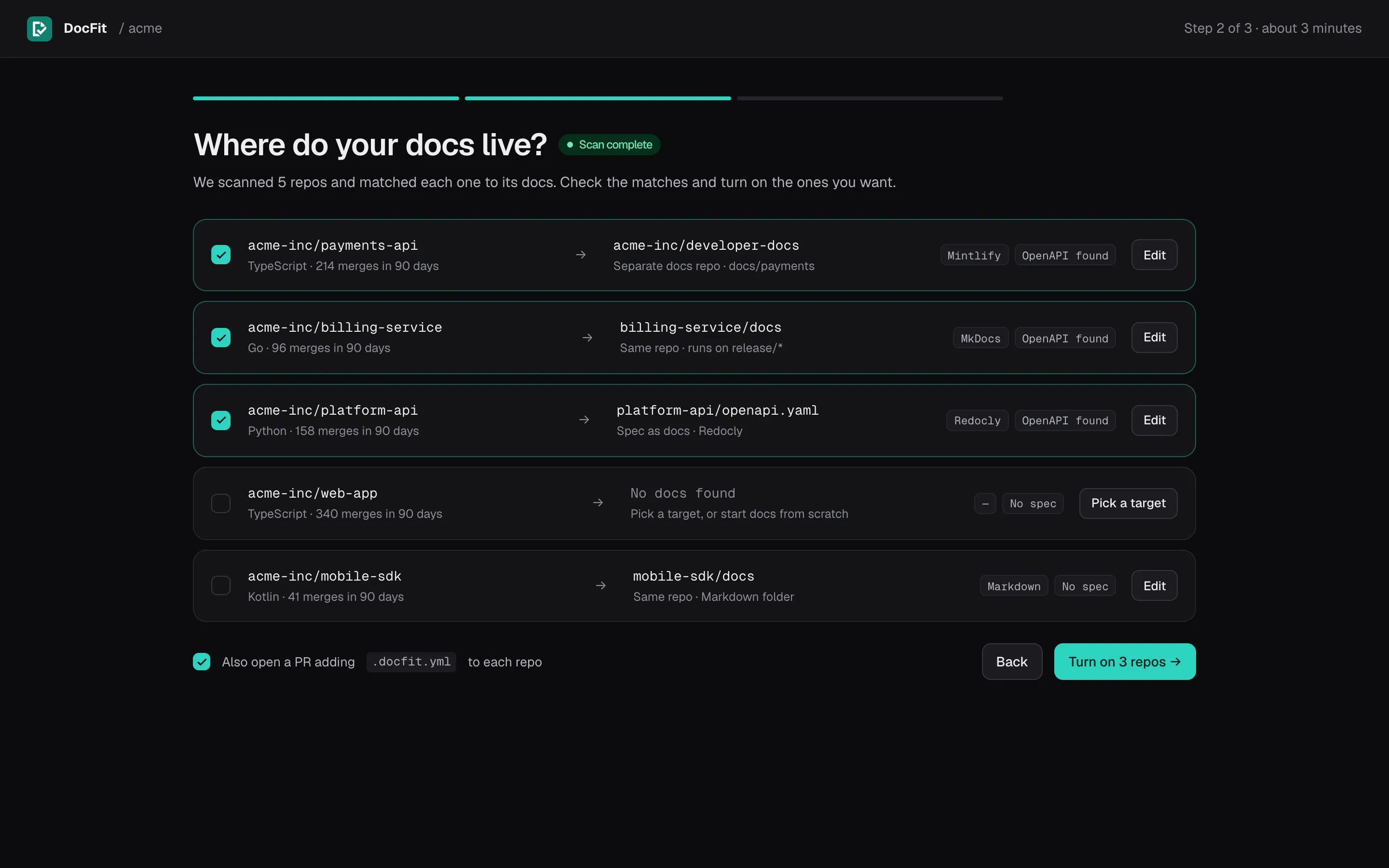
Run on a merged PR by URL, a list or a date range. During setup, DocFit dry-runs your last 5 merges.
Same repo or a separate one
Docs next to the code, in their own repo, or rendered straight from an OpenAPI file.
Docs frameworks
Edits follow each framework's components, nav and build.
Code and tickets
Where changes come from, and why they were made.
Notifications
Where DocFit reports back.
Models
Routed per step. Bring your own key if you like.
Reviewers turn corrections into rules. DocFit applies them on every later run, so nobody gives the same feedback twice, and each rule shows how often it's used and how often reviewers kept its effect.
Example
meera reviewed · 3 weeks ago
We say "API key", never "api-key" or "token". Everywhere, please.
docfit bot replied
Fixed here. I also proposed a workspace rule so this sticks: Write "API key", never "api-key" or "token".
Write "API key", never "api-key" or "token".
Active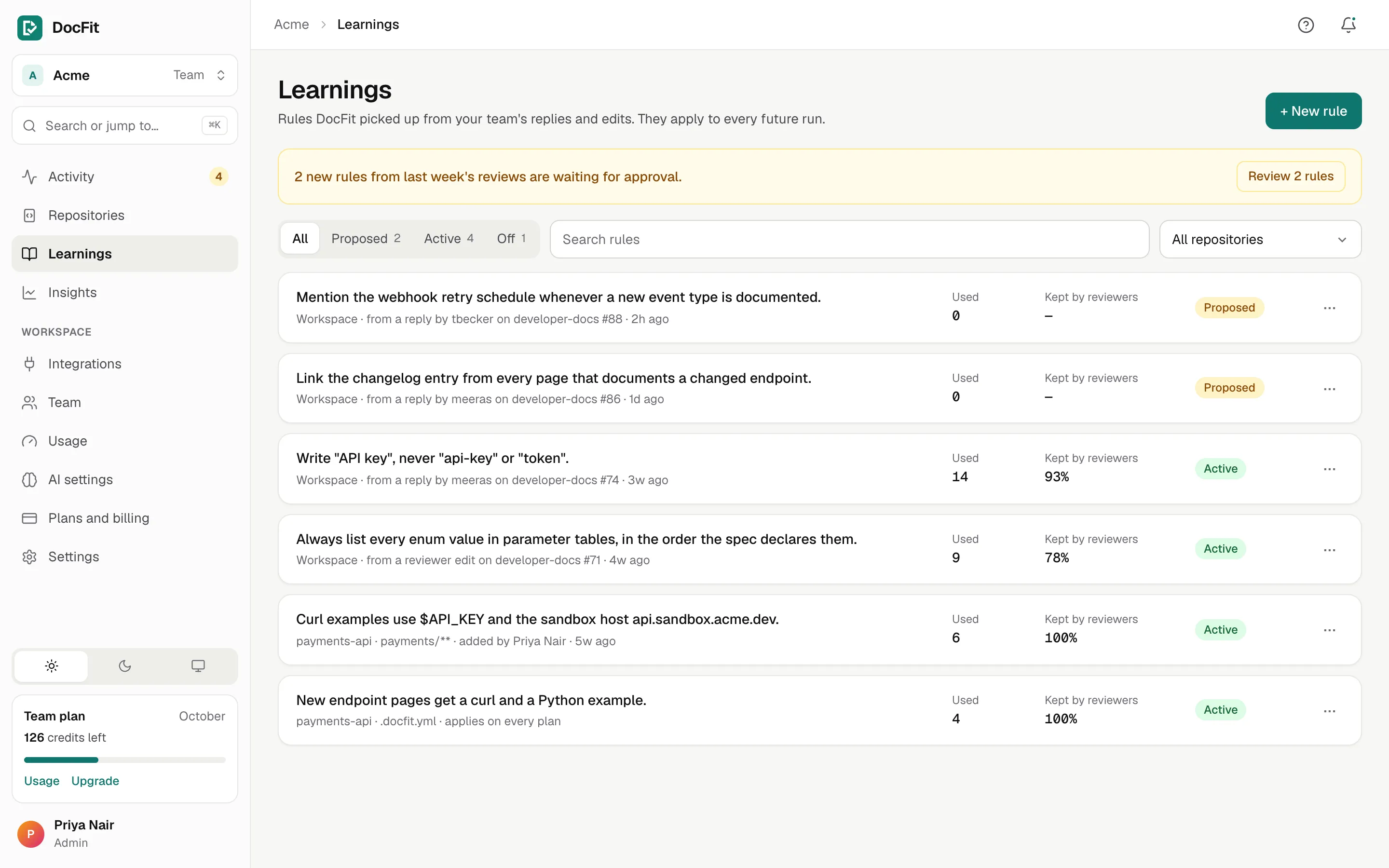
Reply to teach
Answer DocFit on a docs PR like you'd answer a teammate. Replies that read like instructions become proposed rules.
Edits count too
The diff between DocFit's commit and what your reviewer merged is stored per page and learned from.
Admins approve
New rules wait for an admin. The Monday digest repeats the ask. Scope a rule to the workspace, a repo or a path.
Rules in code
Rules in .docfit.yml apply on every run and every plan, and every PR lists the rules it used.
Pick a folder or a new repo and a framework. DocFit reads the code (README, manifests, OpenAPI, routes and handlers, never tests or build output), plans 4–12 pages and opens a starter docs PR with the framework's config. Then it keeps them in step.
Three presets route each step to the right model. Bigger changes use more credits on every preset.
Model calls go to your own Anthropic, Vertex AI or OpenRouter account, and each docs PR uses a flat 2 credits however large the change.
Email or Slack when a docs PR needs you or a run fails, and a Monday digest of what DocFit did last week.
No per-seat charge. Invite by email or share a link for your company domain. Admins manage repos, integrations and billing; members run, review and teach.
Runs that change no docs, skipped runs, failed runs and the install backfill are free. Out of credits, new merges wait. They're never lost.
Built for teams where docs live close to code
API teams
Every endpoint change makes reference pages, examples and integration guides stale. DocFit catches them at merge.
Developer platforms
SDKs, examples and how-to guides change with the product. DocFit keeps them in step with the code that changed them.
Open-source maintainers
Keep docs aligned without adding another recurring chore. Free for public repos.
DocFit reads your change to write your docs. It doesn't keep your code, train on it, or touch anything outside your docs.
See the full security modelOne run, start to finish
Shallow clone
Just the merge commit, limited to your docs folder where there is one
Read diff, PR and ticket
Untrusted text is fenced; nothing in it is ever executed
Edit and verify
Writes only inside the docs target; the agent has no network
Docs PR opened
One commit on a docfit/ branch. Never merged by DocFit
Clone gone
The run ends and the container goes with it. Your source code is never saved
Source code never stored
Each run works in a short-lived container. Your source code, PR descriptions and ticket text are never kept.
Never used for training
Models run under API terms that exclude training on your data. Bring your own key to keep inference in your own account.
Only the repos you pick
A least-privilege GitHub App. Every repository stays off until you turn it on.
Never merges
DocFit opens the PR. Your team decides what ships, and uninstalling stops access at once.
No new workflow to adopt. Use the dashboard to connect repos, see what each run did and why, and manage rules, usage and your team.
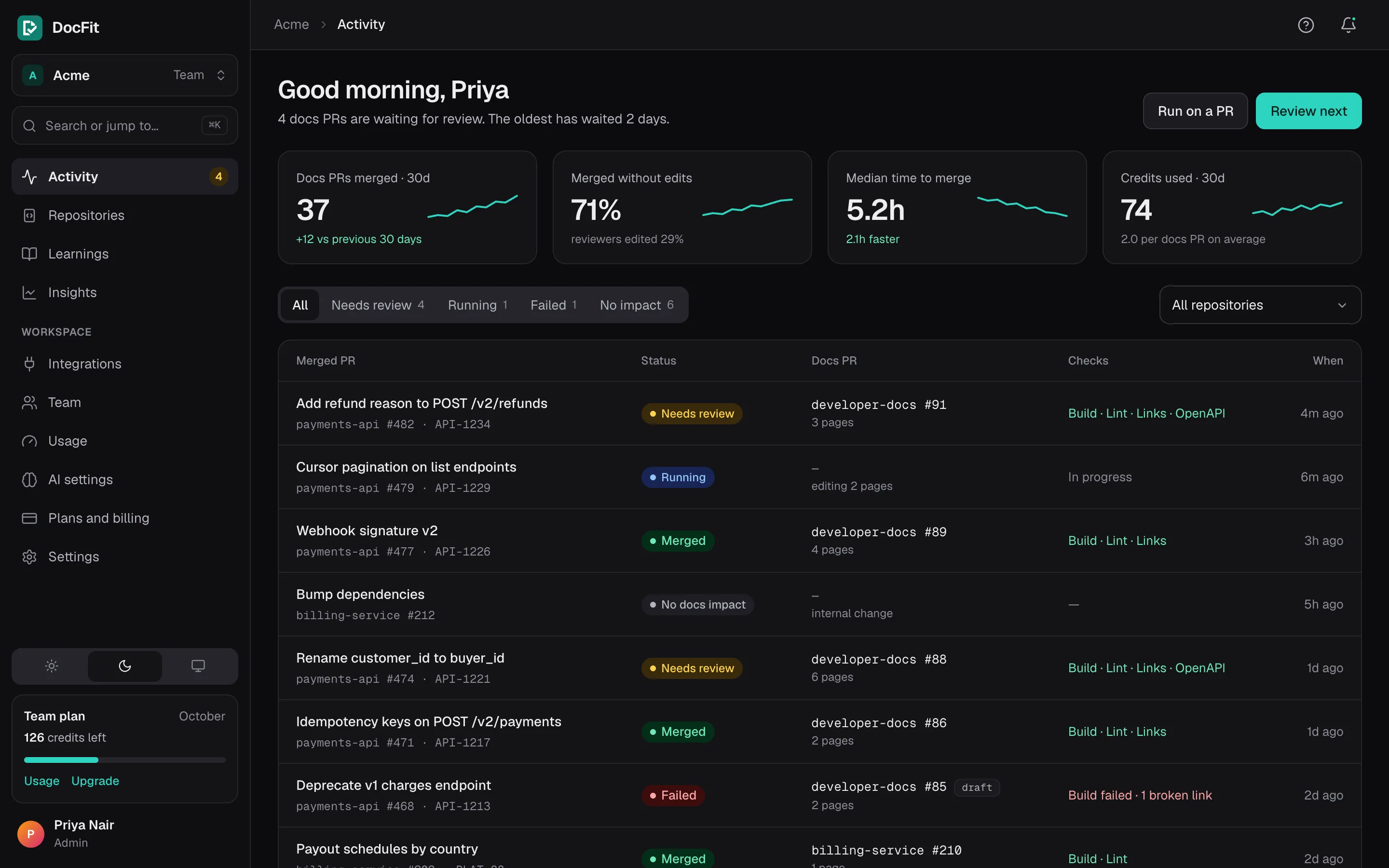
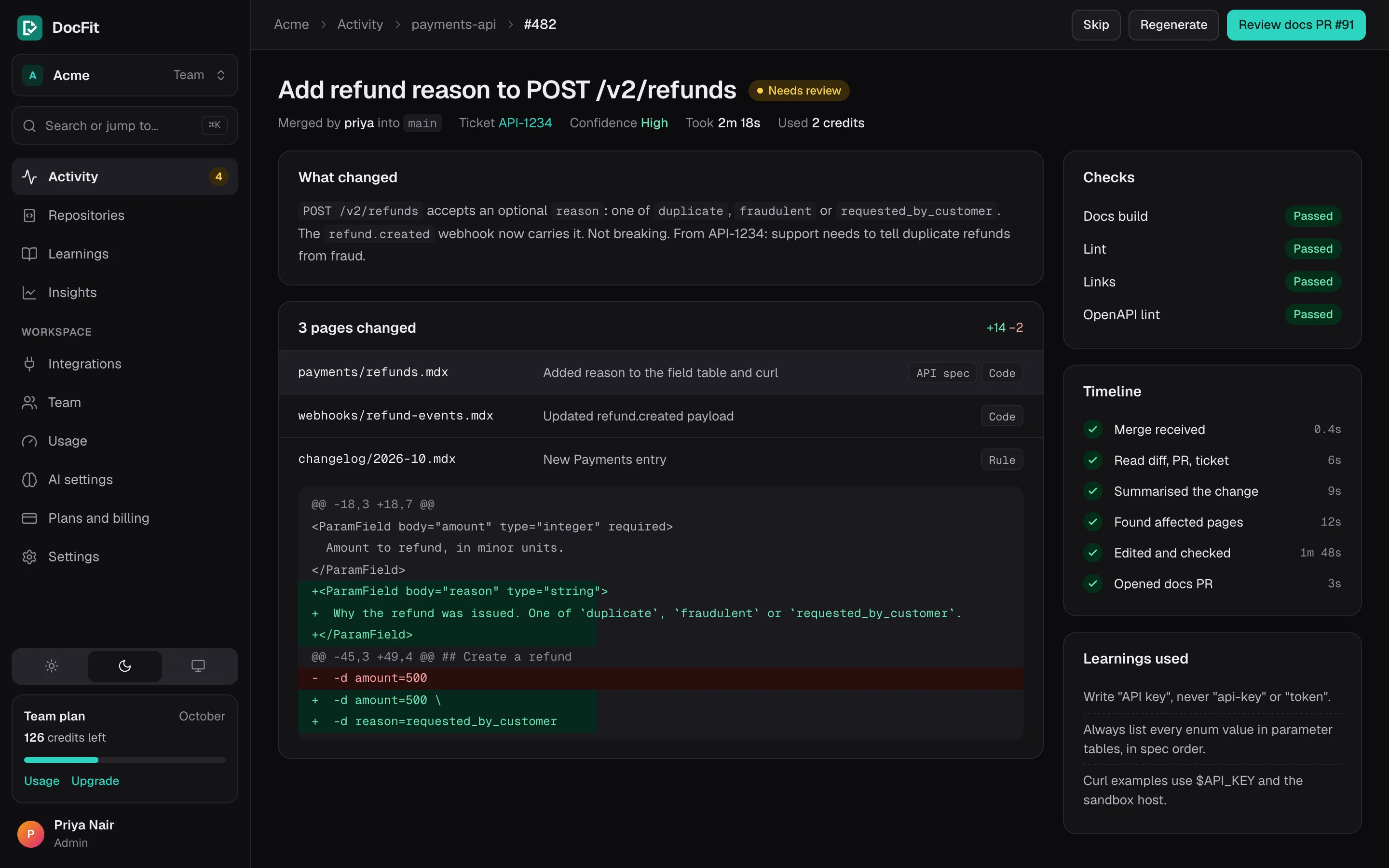
The run feed is home
Every decision, explained
First docs PR in under 5 minutes
Start free. Upgrade when DocFit becomes part of the team. Every plan includes your whole team, and runs that change no docs are free.
Free
For open-source projects and single repos
No card, no time limit
Team
For engineering teams shipping a few APIs or products
14-day trial on private repos, no card
Growth
For API companies running DocFit across many repos
Cancel any time from the billing portal
docfit/ branches..docfit.yml. Every PR lists the rules it used, and each rule shows how often reviewers kept its effect.docfit check) runs the same verifier in any CI, including GitLab CI, Jenkins and GoCD.Install the GitHub App, point it at your docs and see what DocFit would have changed in your last 5 merged PRs. Free for public repos; private repos get 14 days of Team, no card.